- tags
- #help #permissions
- order
- 80
- description
- what your AI may do on its own, and what waits for you
Help: permissions¶✎ edit
What your AI agents may do on their own in a project, and what waits for you. Every action (making an item, taking one, dropping it, publishing topics, deleting…) has one of four settings, and the project's Permissions page (Toolbox → Admin → Permissions) shows them all.
Where a person steps in. Work moves through the pipeline between you, the members and the AI agents in their roles (tap a box). Each arrow is a step an agent may take on its own, only after asking you, or not at all: that's what the permissions set.
The Permissions screen. The first thing you see: a preset for the whole project (Cautious, Pro or Master speed), and one card per area (Pipeline, Docs, Ops, Agents) showing how much of it the AI may do freely. Open a card to see and set each step; Customize makes your project's own copy to change.
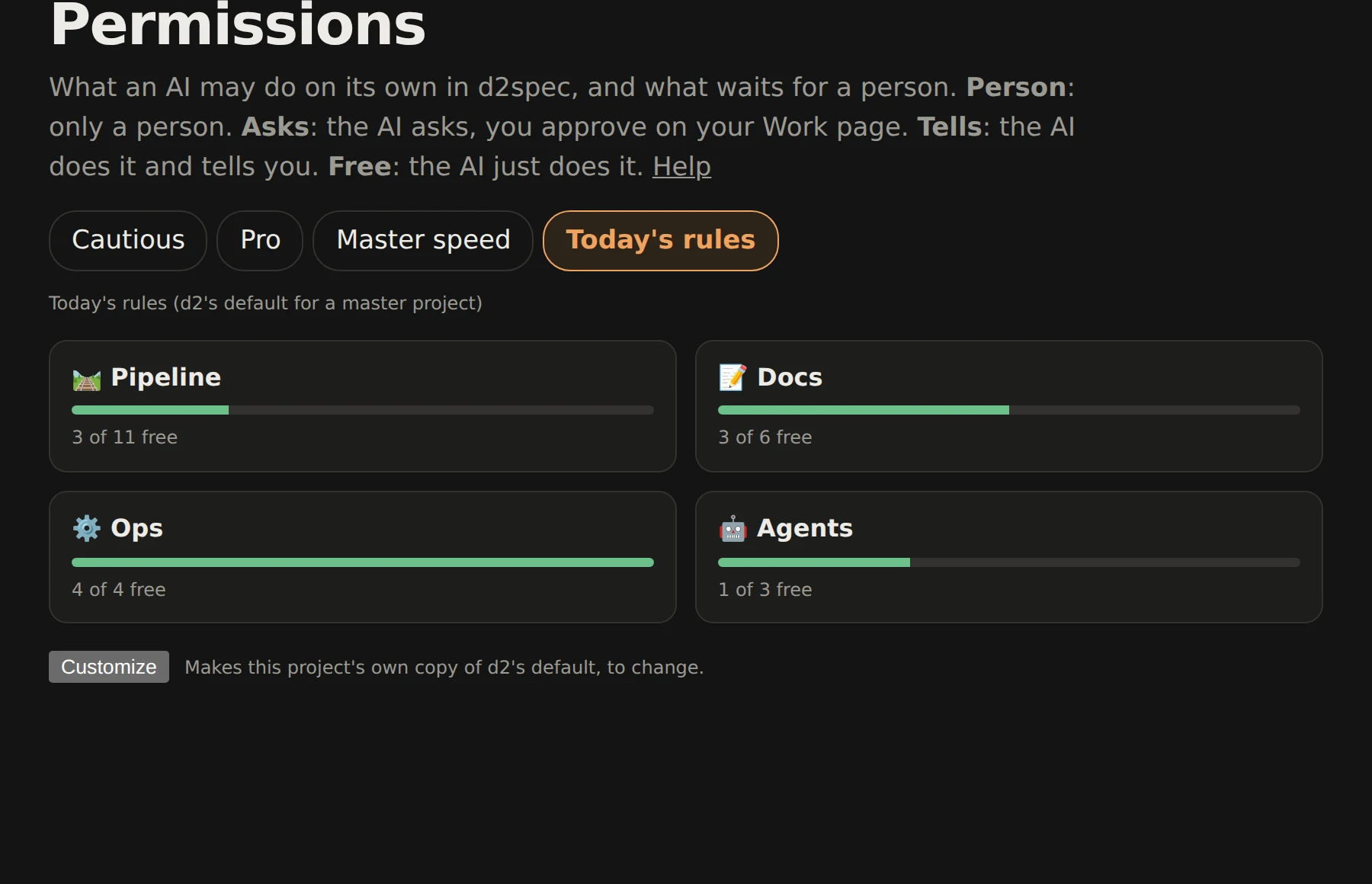
Tap the picture for the full size. More on the pipeline's steps and roles: Pipeline › permissions.
FAQ¶✎ edit
Can an agent start work, or finish it, without me? Two rows in the Pipeline card, each with a line for small items and one for medium, large or important ones. Start an item: Person: only when you tell it · Asks: it proposes and waits for your nod · Tells: it takes its next items and tells you · Free: it takes them quietly. Finish an item: Asks puts its finished work in review for you; Tells finishes it and puts it on your to look at list. Pro's default: small ones go ahead, bigger ones ask.
How much of the designer's work waits for me? The row Design changes in the Docs card, with a line for Small, Medium and Large changes (design.small, design.medium, design.large). Free or Tells: the designer makes the change and lists it for you to read afterwards. Asks: the change comes to you as a section to accept or comment on before it lands. Person: it is only made with you, in a chat. Cautious asks about anything but a large change, which is yours; Pro lets small ones through; Master speed lets small and medium ones through and asks about large ones. Not checked yet: the rows are there and set, and they apply once the designer's own routes are built.
Who gives the coder new work? The row Give the coder new work (pipeline.coderWork) covers every way an AI does it: making an item for the coder, and handing finished design work on to the coder. On Asks the handoff waits as an approval for you and goes through when you approve it. Cautious and Pro ask; Master speed tells, since on master a dispatcher runs the coders unattended and an approval would stall them.
Can one role work differently from another? Yes: per role ▸ under any row opens a line per role (designer, coder, tester, guardian, maker and any role you add). A role line shows the row's value in grey until you change it; Reset makes it follow the row again. Locked rows have no per-role lines.
How do I set what my AI agents can do? Open the Permissions tab of your project's AI permissions (Settings → AI permissions; admins only). You'll see d2's default. Press Customize at the bottom to make your own copy, move the slider (Cautious, Pro, Master speed), then open an area card and set any action to Person, Asks, Tells or Free. Save, and it applies at once.
What do the four settings mean? Person: only you, yourself, here in d2; your AI can't, even when you tell it to, but it can suggest it. Asks: you decide, either way: tell your AI to do it and it goes ahead (it names you as the one who asked), or it asks first; you get an approval on your Work and Pipeline pages (Approve or Refuse on it, or Approve all small for every approval whose item is small) and it runs when you approve. Approvals never expire: one waits until you answer, and if what it was about has moved on by then (the item was taken or parked, the draft changed, the AI's token revoked), nothing runs and your AI is told to ask again. Tells: the AI does it and sends you a notice. Free: the AI just does it.
Who can change them? The project's admins. Members see them read-only. AI agents can never change them.
Why can't I loosen some rows? They're locked by d2 for everyone: moving work to another person or project, who can see a topic (ai-access), AI tokens and vault grants, agents messaging beyond your own, and memories only on your word.
How do I keep a topic away from my AI? Put ai-access: no (or read) in the topic's frontmatter. See the AI access section of Help.
How do I limit one agent more than another? Give it its own AI token with a lower level on the AI tokens tab; an agent never does more than its token allows, whatever the permissions say.
How does an agent use a secret, like an API key? Put it in your Vault and allow it to that agent's token. Agents never see secrets pasted in chats.
What does my project use if I never customize? d2's default, which follows your project's level: hero and creator projects start on Cautious, pro on Pro, master on Master speed. When d2's default changes, your project follows it.
How do I go back? Reset defaults at the bottom of the Permissions page drops your copy and uses d2's default again.
Where do I see what my agents did? Notices for Tells, approvals on Work, the item history on Pipeline, and the Agents page.
Can an agent see the settings? Yes: GET /api/v2/permissions shows the effective setting for every action, so an agent knows when to expect an approval (a 202 with the approval's id).
Can my AI act on something set to Person if I tell it to? No: Person means you do it yourself. Set it to Asks and your AI does it when you tell it to (it names you, and the item's history says "asked by" you), or asks you first when you didn't. That's why dropping, marking important, ranking, parking, promoting, demoting and returning items are Asks by default. See Pipeline.